
In regulated sectors, security assurance has always been tied to evidence. Reports, controls, and assessments are used to demonstrate that risks are understood and managed. But as digital environments evolve faster than ever, a new problem is becoming impossible to ignore: assurance expires.
What was validated during the last assessment may no longer reflect how systems actually operate today. Cloud changes, new integrations, automated workflows, and evolving access patterns quietly reshape the environment – often without triggering formal reassessment. Yet compliance expectations frequently remain anchored to the assumption that validated controls stay effective until proven otherwise.
This tension is why continuous penetration testing and broader continuous testing approaches are increasingly relevant in regulated environments. Not as replacements for audits or governance, but as ways to maintain confidence that security controls remain effective between formal review cycles.
Regulators are no longer focused solely on whether organizations can produce evidence. They want to understand how that evidence stays current – how organizations detect when assumptions break, how quickly validation follows change, and how assurance is sustained over time.
This article examines continuous validation from that regulatory perspective: what regulators expect to see, where organizations most often fall short, and how continuous testing supports ongoing assurance without turning compliance into a constant audit.
What Validation Means in a Regulatory Context
From a regulatory standpoint, validation is not a single activity or a completed task. It is the ability to demonstrate, at any point, that security controls are implemented, operating as intended, and appropriate for the current risk environment.
This means validating not only that a control exists, but that it:
- still applies to the system it was designed to protect
- has not been weakened by operational or architectural changes
- produces evidence that reflects the current state of the environment
In regulated sectors, validation is less about how often something is tested and more about how confidently assumptions can be defended over time.
Why Point-in-Time Evidence No Longer Holds
Most compliance evidence is created at a moment in time: an assessment, an audit, a report. The weakness is not the evidence itself, but the assumption that it remains valid as systems evolve.
In regulated environments, change is constant:
- infrastructure scales and reconfigures
- integrations are added or removed
- permissions shift as tools and roles change
- automation alters how decisions are executed
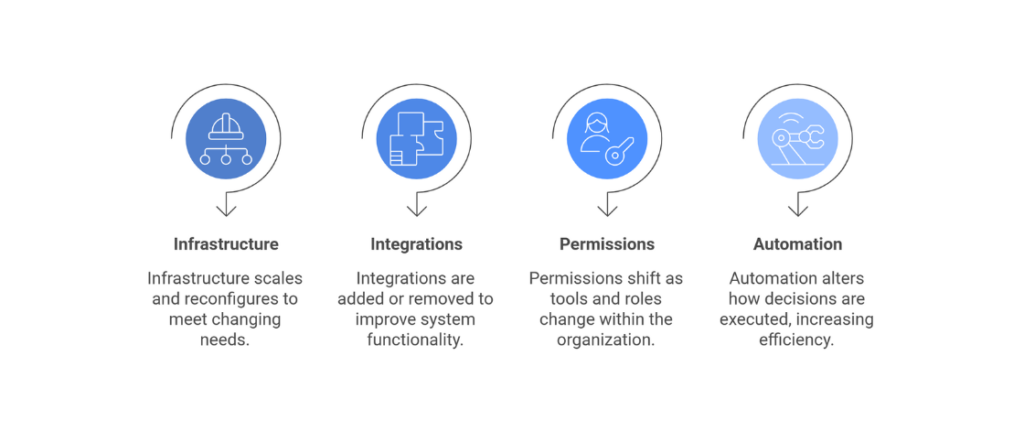
Each change slightly weakens the link between evidence and reality. Over time, organizations accumulate confidence based on outdated validation rather than current conditions. This growing gap between what was validated and what is actually true is increasingly visible during regulatory reviews – a challenge explored in our article on the risk window between penetration tests.
Continuous Validation as an Assurance Discipline
Continuous validation focuses on establishing mechanisms that ensure validation keeps pace with meaningful change.
In practice, this involves:
- identifying which controls must remain continuously effective
- understanding which types of change invalidate existing assurance
- ensuring validation follows change, not just schedules
- maintaining evidence that reflects the live operating environment
For regulators, this demonstrates intent and control. It shows that the organization understands where assurance can degrade and has processes in place to detect and address it before confidence erodes.
The Role of Continuous Penetration Testing
Within this model, continuous penetration testing plays a central role in maintaining technical assurance over time. Rather than serving as a standalone activity, continuous penetration testing provides recurring, objective signals when technical exposure changes. It helps organizations identify when previously validated assumptions no longer hold and when reassessment is required.
From a regulatory perspective, continuous penetration testing strengthens continuous validation by:
- reducing reliance on stale technical evidence
- highlighting changes that warrant renewed assurance
- supporting faster confirmation that controls still operate as intended
It does not replace governance or audits. Instead, it feeds them with fresher, more defensible inputs. This is particularly valuable in closing the gap between formal assessments. For a deeper look at how testing itself has evolved to support this model, see the evolution of penetration testing toward continuous testing.
Common Validation Gaps in Regulated Organizations
When regulators identify weaknesses, they are rarely caused by missing controls. More often, they stem from broken validation chains.
Common gaps include:
- evidence that no longer reflects the live environment
- controls that exist on paper but drift operationally
- changes approved operationally but never reassessed from a risk perspective
- fragmented ownership of assurance across security, IT, and compliance teams
These gaps make it difficult to answer a simple regulatory question: How do you know this is still true?
Audit Readiness as a Natural Outcome
Organizations with effective continuous validation approaches experience audits differently. Evidence is already current. Control ownership is clear. Changes and reassessments are traceable.
As a result, audits become confirmation exercises rather than reconstruction efforts. Regulators see consistency over time instead of last-minute alignment.
Continuous penetration testing supports this outcome by keeping technical assurance aligned with reality, but it is the surrounding validation framework that turns activity into confidence.
Conclusion
In regulated sectors, security is no longer judged by what was validated once, but by what can be demonstrated over time. Static assurance cannot keep pace with dynamic environments, and assumptions erode faster than most organizations realize.
Continuous penetration testing models are becoming compliance expectations not because regulators want more testing, but because they want fewer blind spots. They want assurance that evolves alongside the systems it is meant to protect.
Organizations that embed continuous validation into their operations move beyond audit-driven security. They replace outdated confidence with sustained visibility and turn compliance from a periodic obligation into an ongoing state.
You cannot stop change. But you can validate continuously – and that makes all the difference.
