
Most organizations assume they would immediately know if they were breached. Security tools are in place, alerts are configured, and IT teams are working hard to keep systems protected.
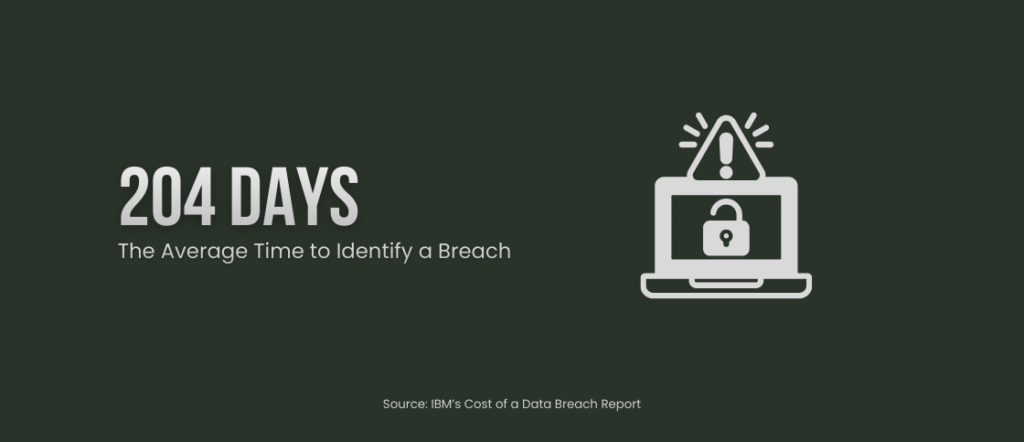
Yet in reality, many breaches are discovered weeks – sometimes months – after the initial compromise. In some cases, the first sign of trouble comes from an external party, not from within the organization. According to IBM’s Cost of a Data Breach Report, the average time to identify a breach is 204 days, with an additional 73 days on average required to contain it. That means organizations often operate for months without realizing their systems have been compromised.
The issue is rarely the absence of security tools. More often, it is a lack of visibility, ownership, and continuous oversight. For business leaders, the real risk is not just being attacked – it is not knowing you have already been compromised.
So why does this happen?
Late detection is usually not the result of a single technical failure. It stems from structural gaps in how security is monitored, managed, and governed.
Why Breaches Are Detected Too Late: The 7 Structural Gaps
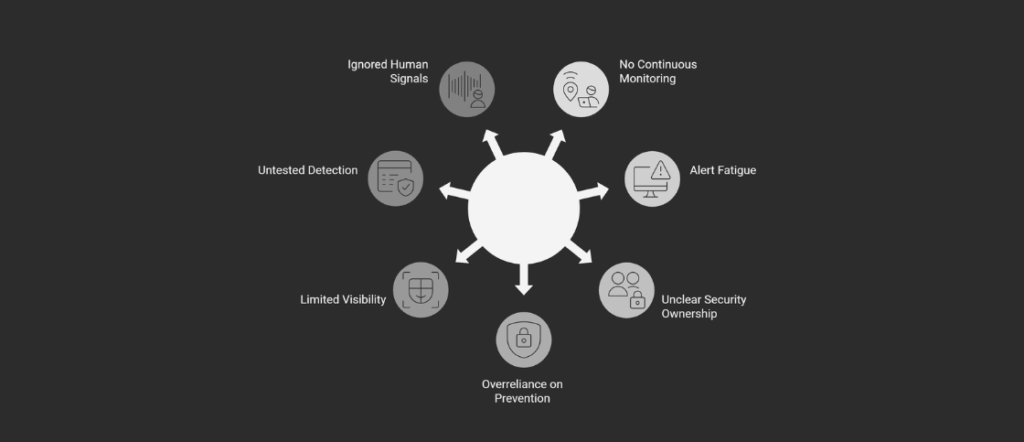
1. No Continuous Monitoring
Many organizations collect logs and generate alerts. But monitoring is not the same as collecting data.
If no one is actively reviewing and investigating alerts – especially outside business hours – suspicious activity can go unnoticed. Threat actors do not operate on a 9-to-5 schedule. Without 24/7 visibility, early warning signs are often missed.
2. Alert Fatigue and Overloaded IT Teams
Internal IT teams are frequently responsible for infrastructure, user support, system upgrades, and vendor coordination – in addition to security.
When dozens or hundreds of alerts compete with operational priorities, fatigue sets in. Over time, alerts are dismissed, postponed, or deprioritized. Critical signals can be buried in noise.
3. Lack of Clear Security Ownership
Who is ultimately responsible for detection?
In many SMEs, security is treated as a shared responsibility between IT, compliance, and management. Without a defined owner at leadership level, detection rarely becomes a strategic priority. Tools may be deployed, but governance is missing.
Security requires accountability – not just configuration.
4. Overreliance on Preventive Controls
Firewalls, antivirus software, and access controls are essential. But they are preventive measures, not detection strategies.
Modern attacks are designed to bypass perimeter defenses using legitimate credentials or trusted channels. If organizations focus primarily on blocking threats rather than identifying abnormal behavior, attackers can remain inside the environment without triggering alarms.
5. Limited Visibility Across Systems
Logs often exist – but they are fragmented across endpoints, cloud environments, email systems, and network devices.
Without centralized visibility and active review, it becomes difficult to correlate unusual activity across systems. Early indicators remain isolated and overlooked.
6. Detection Capabilities Are Rarely Tested
Many organizations conduct vulnerability assessments or penetration tests to uncover weaknesses. Fewer test their ability to detect and respond to an active compromise.
If detection processes are never validated through simulations or exercises, leadership cannot confidently answer a simple question: Would we recognize an attack in time?
7. Human Signals Are Ignored or Delayed
Employees are often the first to notice suspicious activity – unusual emails, unexpected login prompts, strange system behavior.
However, without clear reporting channels and a culture that encourages escalation, these signals may be dismissed or reported too late. These gaps are rarely dramatic failures. More often, they are gradual maturity issues that accumulate over time.
The result is a visibility gap – one that allows attackers to remain undetected far longer than most leadership teams would expect.
The Business Cost of Late Detection
Financial Impact
The longer an attacker remains inside a network, the greater the potential damage – data exfiltration, operational disruption, fraudulent transactions, and recovery costs. What could have been contained early can escalate into a major incident.
Regulatory Exposure
Under regulations such as GDPR and sector-specific frameworks like DORA and NIS2, organizations must detect, assess, and report incidents within strict timelines.

Delayed detection complicates compliance. If you discover a breach months after it occurred, demonstrating control and due diligence becomes significantly more difficult.
Reputational Consequences
Customers and partners rarely differentiate between “breached” and “breached for months without knowing.” Trust erodes not only because of the incident itself, but because of perceived lack of oversight.
Insurance and Legal Complications
Cyber insurance providers increasingly examine detection and monitoring capabilities. Weak visibility or inadequate response processes can impact claims or premiums.
In short, the cost of late detection extends far beyond IT.
How Mature Is Your Detection Capability?
To assess your organization’s readiness, consider the following questions:
- Do you have 24/7 monitoring of critical systems?
- Are logs centralized and actively reviewed?
- Is there a defined executive owner for security detection and response?
- Have you tested your detection and response capability in the last 12 months?
- Can you confidently meet regulatory breach reporting timelines?
If you answered “no” to more than two of these questions, your organization may have a visibility gap that deserves attention.
Detection is not about having more tools. It is about having the right structure, ownership, and continuous oversight in place.
What Effective Detection Looks Like
Mature organizations treat detection as an operational capability, not a product.
This includes:
- Continuous monitoring with clear escalation processes
- Defined executive accountability for security governance
- Regular testing of detection and response readiness
- Alignment between security operations and compliance obligations
- A culture that encourages early reporting and rapid action
When detection is integrated into governance and business strategy, resilience improves – not only against cyber threats, but against regulatory and reputational risk.
Strengthening Detection: From Visibility to Action
Closing the visibility gap requires more than additional tools. It requires continuous monitoring, expert analysis, and clear executive oversight.
At AMATAS, our CREST-accredited Security Operations Center (SOC) provides 24/7 monitoring and investigation capabilities designed to detect and respond to threats before they escalate. Through our Managed Extended Detection and Response (MXDR) services, organizations gain continuous visibility across endpoints, networks, and cloud environments – without overloading internal IT teams.
At the strategic level, our vCISO services help define ownership, governance, and incident response frameworks, ensuring that detection is aligned with business risk and regulatory obligations.
Because effective detection is not just an operational function – it is a leadership responsibility.
If you would like to understand how your current monitoring and governance model compares to best practice, our team is available to discuss how continuous detection and strategic oversight can strengthen your resilience. Let’s talk.
